• Emission Line Galaxies
  • High-z BLAGN/LRD
  • Reionization
  • High-z Morphology

Emission Line Galaxies

I study emission line galaxies with a preliminary focus on their spectra and physical properties. This is achieved through a combination of photometric and spectroscopic data from various instruments. The theoretical modeling of galaxy spectra at high redshifts is also an essential component of my research. Different SPS (Stellar Population Synthesis) modeling (including IMF), dust attenuation laws, and nebular emission contributions are considered to accurately interpret the observed spectra. Click here for a simple galaxy-spectrum-demo webapp that I create by Streamlit to illustrate the effects of different parameters on galaxy spectra.
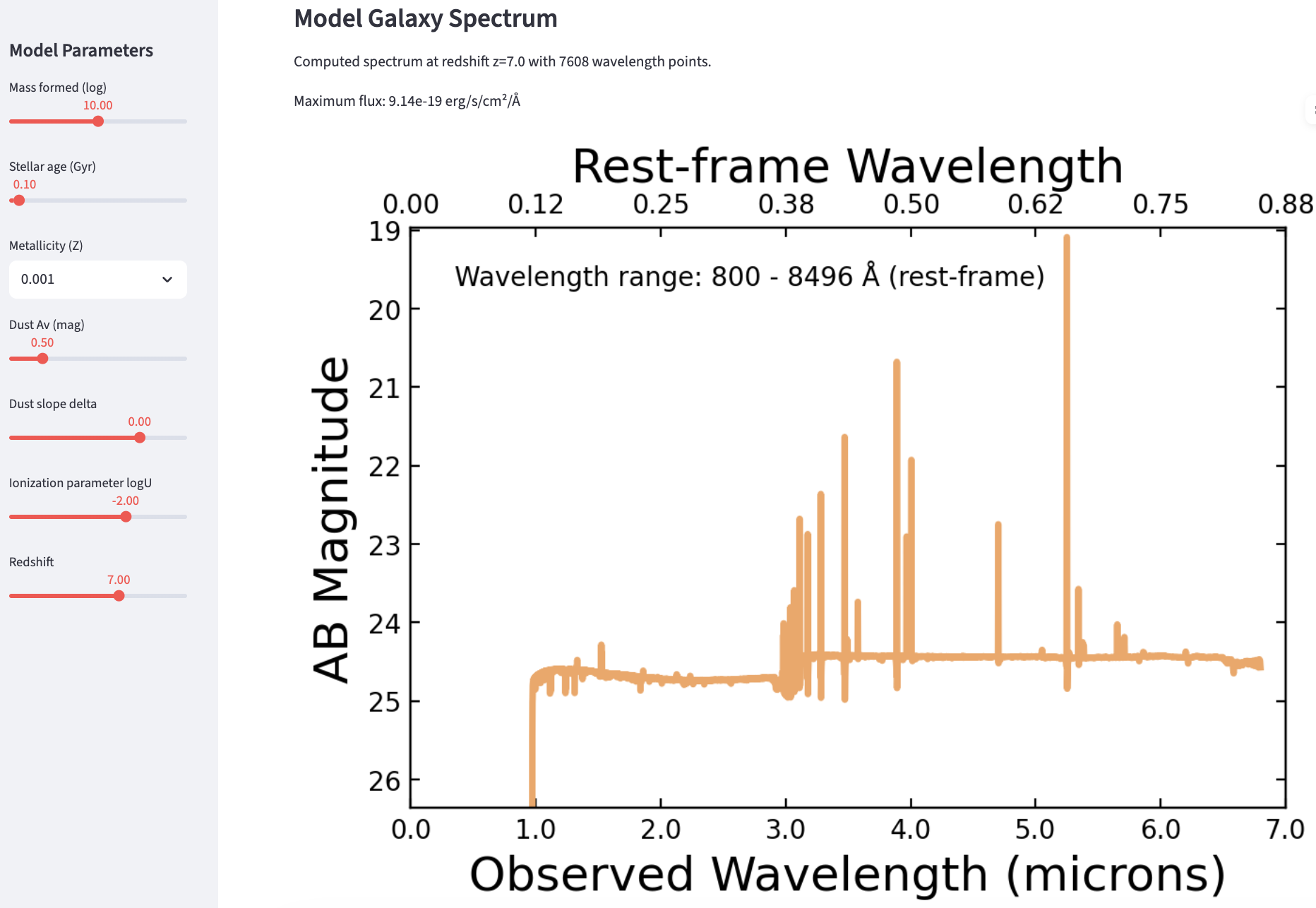
 

Galaxy Spectrum Demo Screenshot


Specifically, I combine JWST NIRCam imaging, NIRCam Grism spectroscopy and MIRI imaging to analyze the spectrophotometric properties of z > 6 emission line galaxies in COSMOS field. This is facilitated by the JWST Cycle 1 programs COSMOS-Web (PI: Kartaltepe) & PRIMER (PI: Dunlop), as well as cycle 3 program COSMOS-3D (PI: Kakiichi) which I am an active member of.


The main goals of my research include:

  • - Understanding the characteristics of [OIII] emitters at z > 6, namely how their star formation, AGN activity, and environment can be different from LBGs/photometrically selected galaxies at similar redshifts.
  • - Providing key insights to the reionizing photon production via accurate constraints on the intrinsic galaxy ionizing spectrum.
  • - Overcoming the challenges of cosmic variance by building a statistical sample of high-z emission line galaxies. This will refine the current understanding of high-z LF/SMF/SFRD estimates.
  • - Assessing the impact of AGN contribution within emission line galaxies at z > 6, and its implications for the coevolution of galaxies and supermassive black holes in the early universe.

High-z BLAGN/LRD

Tracing the growth of supermassive black holes (SMBHs) since early cosmic times is of great importance. I am particularly interested in studying low luminosity quasars or AGNs with the unique sensitivity of JWST and future telescopes (including ELT).


Broad Line AGNs (BLAGN) at high redshifts are relentlessly discovered to show red optical colors and sometimes accompanying with blue rest-frame UV continua. These sources are often referred to as "LRDs", cyphering enormous valuable information about the seeding/growth of SMBHs and coevolution with their host galaxies. I am working with Olivier Gilbert and other collaborators to identify and characterize these sources in COSMOS field.


Also, I work closely with the Galfit (GalfitS, GalfitX) community at KIAA led by Prof. Luis Ho and Dr. Jinyi Shangguan, which enables state-of-the-art morphological+spectral decomposition of these BLAGN/LRDs into their host galaxy and AGN. Check out the Galfit community website here.

Reionization

TBD.


TBD.

High-z Morphology

The distanct universe harbors a rich variety of galaxy morphologies, holding strong clues about the growth of galaxies and the structure of the universe. Connecting galaxy morphology with itself physical properties (e.g., stellar mass, SFR, metallicity) can shed light on the underlying physical processes driving galaxy evolution, while connecting morphology with dark matter halo and merger history can provide insights into the role of environment and interactions in shaping galaxies.


I look at two extremes of the high-z galaxy morphology spectrum: the morphological demographics of "normal" star-forming galaxies, as well as the most extreme outliers. For the former, I use statistical analysis to probe the behavior of galaxy morphology as a function of redshift and physical properties. For the latter, I attempt to reveal more physical interpretations of peculiarity with the aid of cosmological simulations.